|
Germany
Travel Guide
Göttingen
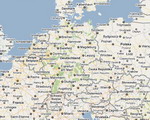
is a city in the southernmost part of the German state of Lower Saxony,
bordering Hesse and Thuringia.
 The population
of Göttingen in 2004 was 129,446, of which around 30,000 are students. It
is best known for being the home of the Georg-August-Universität
Göttingen, as well as the site where the prestigious Max Planck Society
(a German organization for scientific research) was founded in 1948. The
Max Planck Institutes for Dynamics and Self-Organization, for
Experimental Medicine, for Biophysical Chemistry, and for History are all
located in Göttingen. 44 Nobel Prize winners have studied or taught in
the city, and these and other notable former Göttingen residents are
commemorated by white plaques on many buildings throughout the town. Its
nickname is therefore the Stadt der Wissenschaft (City of Science).
Today, Göttingen is a charming university town, off the radar screen for
most English-speaking tourists but well worth a visit. The population
of Göttingen in 2004 was 129,446, of which around 30,000 are students. It
is best known for being the home of the Georg-August-Universität
Göttingen, as well as the site where the prestigious Max Planck Society
(a German organization for scientific research) was founded in 1948. The
Max Planck Institutes for Dynamics and Self-Organization, for
Experimental Medicine, for Biophysical Chemistry, and for History are all
located in Göttingen. 44 Nobel Prize winners have studied or taught in
the city, and these and other notable former Göttingen residents are
commemorated by white plaques on many buildings throughout the town. Its
nickname is therefore the Stadt der Wissenschaft (City of Science).
Today, Göttingen is a charming university town, off the radar screen for
most English-speaking tourists but well worth a visit.
Attractions
& Things to do:
- Altes Rathaus (town hall), Marktplatz. Built 1369-1444, the
Altes Rathaus was the town hall until 1978, and it now houses the
Tourist Office. The coats of arms of other members of the Hanseatic
League are painted on the walls.
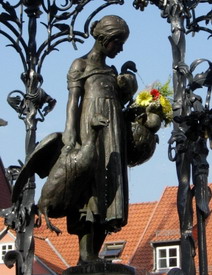
- Gänseliesel (goose girl), Marktplatz. This fountain outside
the Altes Rathaus is Göttingen's most famous figure. She is known as
the "most kissed girl in the world" since she is kissed by
every local student who receives a Ph.D. (after being dressed up
with a silly graduation hat and wheeled to the statue in a
handcart).
- Churches.
Four of Göttingen's churches can be seen from the metal "Vier
Kirchenblick" (four churches view) in front of the Altes
Rathaus (James's, John's, Alban's, and Michael's). Mary's is also
worth a peek inside.
- Jacobikirche (St. James's Church),
Jacobikirchhof and Weender Str. Built 1361-1461, St. James's has
the most interesting interior of Göttingen's churches, with
fascinating original paintwork (not unlike that of a barbershop)
and modern stained-glass windows. The Ott organ is also impressive.
It is sometimes possible to climb the tower, although the last set
of stairs to the view may be blocked off -- ask before paying a
euro.
- Johanniskirche (St. John's Church),
Johanniskirchhof. Originally built around 1200, St. John's is the
oldest of Göttingen's churches, although it was mostly rebuilt in
the 14th century (the north-side doorway dates from 1245). The
interior is plain, although one of the two towers can sometimes be
climbed.
- Albanikirche (St. Alban's Church),
Albanikirchhof. Built 1423-1467, St. Alban's stands on the site of
an earlier mission chapel. Hans von Geismar painted the altarpiece
in 1499, and he added himself to the scene of Mary's death as the
13th apostle.
- St. Michael Kirche (St. Michael's Church),
Kurze Str. Built 1787-1789, St. Michael's was Göttingen's first
Catholic church after the Reformation.
- Nikolaikirche
(St. Nicholas's Church), Nikolaistr. An English Catholic mass is held here every
second Friday at 7 pm. The area around the church is also used for
flea markets on weekend mornings in the summer.
- Marienkirche (St. Mary's Church),
Neustadt and Groner-Tor-Str. The church bell tower used to be the
gate into the neighboring city Neustadt (new city), which Göttingen
bought in 1319. St. Mary's is probably older than that; it was
formerly the church of the Teutonic Knights. The altar triptych was
carved by Bertold Kastrop in 1524.
- Georg-August University. The university is actually spread out in many
sections around the city, though you see a couple of its buildings
(the Auditorium and Aula) on the self-guided tour. Former staff and
students include Gauss, Riemann, Dirac, Bismarck, Oppenheimer, Born,
Hilbert, Teller, and Weyl.
- Botanical Gardens, access behind the Auditorium at Weender Str.
and Nikolausberger Weg. These gardens, established in 1736, are well
worth a visit for plant-lovers. The former city wall around the
Altstadt (old city) is also a circular green area, popular with
joggers. Gauss's grave is located on the southwest side.
- Synagogue Memorial, Obere-Masch-Str. and Untere-Masch-Str. This
memorial, designed by Corrado Cagli in 1973, stands on the site of a
synagogue that was destroyed in 1938. The names of Göttingen's
Jewish residents who were "murdered" during the "dark
time" are listed below an abstraction of the Star of David.
- Half-timbered houses. Since Göttingen was not bombed during WWII, it
still has many original buildings. Particularly impressive are the
1549 Schrödersches House (Weender Str. 62), the 1497 house at
Paulinerstr. 6, the 15th century Junkernschänke (corner of Jüdenstr.
and Barfüßerstr.), the 1536 house on Barfüßerstr. (between Jüdenstr.
and Weender Str.), and the 16th century house at Groner-Tor-Str. 28,
which was only recently revealed beneath a thick layer of plaster.
(Half-timbering was regarded as unfashionable from the Baroque era
into the 20th century, and many beautiful old buildings have only
recently been discovered.)
top
read more
|