|
Germany
Travel Guide
Mannheim
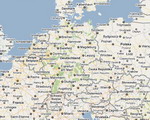
is a city in the northwest corner of the state of Baden-Württemberg in
Germany, at the confluence of the Rhine and Neckar rivers.
The
center of Mannheim is laid out like a chess board, with no real street
names. Addresses in the Quadrat take the form of a grid reference, such
as Q3, 12 designating a block.
Mannheim
was a small fishing village before it became a city at the beginning of
the 17th century. It was constructed on the site of a fortress guarding
the confluence of the rivers Rhine and Neckar. Even now a few remnants of
the fortification can be seen, and the peculiar street layout owes to
that part of its history. For 58 years, Mannheim served as a royal
residence and gave Schiller, Lessing, Goethe and Mozart a home for some
time. Before World War II Mannheim was a beautiful city, but was
flattened in bomb raids due to its industrial significance. When it was
time to rebuild the city, Mannheim, like many other German cities, opted
for an all out modern approach to urban development. Thus, most of the
old quarters were replaced by buildings typical of the 1950s. If you are
not an adept to architecture, their appeal might not be easy to grasp. As
a result, the impression is more of an industrial city with a few spots
of beauty.
Modern
Mannheim is the second biggest city in Baden-Württemberg and one of the
hotspots of immigration. Because of that you'll encounter a lively and
colorful mixture of nationalities and cultures in the city. The
Mannheim/Heidelberg area hosts the largest concentration of US military
personnel in Germany, and barracks are found in many of the suburbs.
 Attractions and
things to do: Attractions and
things to do:
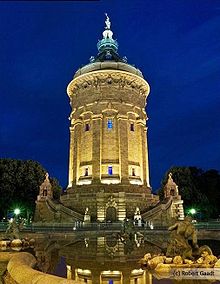
- Water tower: One of the most famous icons of the Jugendstil
(Arte-Nouveau style) in Germany, the water tower (and small park
surrounding it) is a great place to sit in the summer for a picnic
or just a little rest. The park is surrounded by the Rosengarten,
a conference hall of reddish brick, and the colors on a sunny day
are amazing.
- Mannheim's Palace (part of the University of Mannheim). It is right
next to the main train station.
- Paradeplatz: the center of the city, pedestrians-only. A
small park.
- Konkordienkirche (church)
- Luisenpark (one side is free, one side is pay)
- Herzogenriedpark
- The National Theater has a different show almost every night (for
some shows, like ballets or opera, the language barrier is not an
issue). The street car stops right outside the theater, and student
tickets are much reduced (5 or 15 euro).
Museums
- Reiss-Engelhorn Museum. At D5 and C5 (see above for explanation of
downtown addresses), the REM houses a permanent exhibit on world
cultures along with an exhibition hall whose contents range from
photography to astronomy.
- Landesmuseum
für Technik und Arbeit, LTA (Museum of
Technology), Museumsstraße 1, 0621/4298-9.
- Kunsthalle (Art Gallery), Friedrichsplatz 4.
top
read more
|