Ten
Things To Do In The Rock Of Gibraltar by Jonathan Williams
The
Rock of Gibraltar is a place rich in history especially in the traces of
human existence dating as far back as the age of the Neanderthal man.
There has been a longstanding battle between Spain and the UK for
sovereignty of the place, and a unanimous vote by the people of Gibraltar
to remain under British rule rendered it still to be a British territory
up to this day.
Nonetheless, Gibraltar's unique
culture is a combination of all the influences that have landed in the
region, Spanish and British notwithstanding, and its landmarks are
worth seeing if you're going on a trip to this place.
1.) Dolphin
and whale watching
A
cove down Gibraltar has an amazing display of dolphins and whales in
their natural habitat. A trip down this bay is worth making just to
witness the beauty of these sea creatures playing and showing off their
splendor for all to see. Here, you will truly appreciate these marine
creatures in their natural habitat.
2.) Cable
ride
For
a spectacular view from the top of the Rock of Gibraltar, you can take
a cable car ride. During the ride, you will also get to see the
majestic spread of Spain up north and Africa down south. This is truly
a sight to behold!
3.) Water
sports
You
can go jet skiing and paragliding to enjoy the beautiful waters down in
the Catalan or Sandy bays and other beaches. Be one with the underground
flora and fauna by diving into the waters, too, if you love exploring
under the sea. This will definitely give you a thrill as you dive deep
down into the waters of Gibraltar.
4.) Migrating birds
On
certain seasons, migratory birds flock the Rock of Gibraltar to escape
the wintry months of their homes. Thousands of different birds come
here, and the sight is truly amazing. It is one of those experiences
that have you in awe at the wonders of nature.
5.) Monkeys
without tails
This
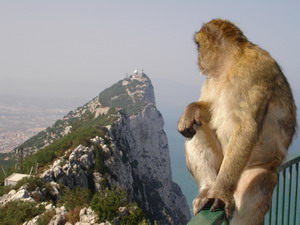
is one of the most famous tourist attractions in Gibraltar. The
macaques, otherwise known as the tailless monkeys are said to be the
only species of wild primates that can be found in the whole of Europe.
There is also a wonderful legend covering the existence of these
macaques in Gibraltar, one which believes that it will cease to be a
British territory once these monkeys have also ceased to exist.
Here,
you will find the earliest evidences of human existence in Gibraltar. The
museum houses a skull of the Neanderthal man said to have first inhabited
the place. You will also learn all about the historical battle between
the British and Spanish troops for the right to own the Rock of
Gibraltar.
The
Botanical Garden is said to have been around since the early 1800s.
Gibraltar's gardens are a collection of native and foreign plants and
flowers. You will also see here bust sculptures that depict the era of
when the garden was first opened.
8.) Shopping
Don't
miss out on shopping here. In fact, you can go on a shopping spree
guilt-free because most goods and commodities here are sold at lower
prices. This is primarily due to lower taxes on these goods as well as
the freedom from other government taxes.
9.) Shrines
and mosques
Gibraltar
has been under many influences including religion. This country has a
rich mixture of these religious influences in their history. Here, you
will see mosques converted into the Shrine of Gibraltar's Patroness, Our
Lady of Europe, among other things.
10.) Changing
of the Guards
Typically
British, this ceremony, which takes place a couple of times within the
day, is something to watch out for. You will witness the discipline and
perhaps a little stoicism in the behavior of the Guards that are quite
entertaining and awe-inspiring at the same time. You can see this in the
place where Gibraltar's Governor resides.
About
the Author - Jonathan Williams is the travel writer for Destination Guide
TV - the place to share travel videos. Visit
http://www.destinationguide.tv/gibraltar to view or share Gibraltar
travel videos.
Gibraltar
— Little England on the tip of Spain
Long an object of dispute between Spain and Great Britain, the British
Overseas Territory of Gibraltar is a little enigma, tucked away at the
very tip of Spain. It's a place where Spanish and English are
intertwined.
To
drive there from Málaga city, it is best to take the toll roads - speedy
and quick - rather than the normal highway, where you will find a series
of very irritating roundabouts to slow you down. Along the way, you will
bypass Fuengirola, Marbella and Estepona, among other coastal towns, with
some lovely countryside on both sides of the highway, and glimpses of the
blue sea at most turns in the road.
You
zoom along the Costa del Sol, also known as the Costa del Golf, and pass
through around four traffic tunnels along the way. From around Marbella
onwards, you can already see the enigmatic Rock of Gibraltar on the
horizon.
As you
near Gibraltar you first pass through San Roque in Cádiz province. The
so-called “Very Noble and Most Loyal City of San Roque, where
Gibraltar lives on”, was officially founded in 1706 and the Rock of
Gibraltar used to form part of this city in the historic past until Great
Britain got involved and pinched it.
While
it was a popular beach resort at one stage, the city has, unfortunately,
been rather spoiled by being the home of the CEPSA Gibraltar-San Roque
oil refinery.
Then
on to La Línea de la Concepción, the Spanish coastal town which is
literally right next to Gibraltar and has close social and economic ties
with the British territory (also, both San Roque and La Línea actually
overlook the Bay of Gibraltar.)
From
there it's a hop, skip and a jump to the border, where on an average day
you just wave your open passport at your windscreen and smile, as you
drive on through. Americans used to encounters with the TSA might find
this just a little astonishing! To avoid queues, try to arrive after
10h00 and leave before 17h00, otherwise you might get stuck in a line of
people on their way to or from work in Gibraltar.
Once
that part is over, as long as there are no incoming planes, you just
drive across the runway of the airport and into, well, England. Well,
almost.
The
signs are all in English - however, cars drive on the right (as they
would in Spain), and not on the left (as they would in England). When
walking in the streets, you mostly hear English, but often also hear
Spanish. It is not unusual to hear a Spanish family speaking a
combination of both languages. The majority of Gibraltarians are English,
Spanish and Moroccan, with a smattering of other European nationalities,
including Genoese, Maltese, Portuguese and German.
The
streets are mostly narrow and winding, with a lot of one-way streets, and
intersections can be confusing at times. The town is a mixture of modern,
and also very old, buildings from Gibraltar's military existence and
historical past. Strange names like "Ragged Staff Gates" and
various "bastions" are seen throughout the town on signs on the
old buildings. Some have been converted for more modern use.
It
takes a bit of getting used to, finding your way around, and it could be
best to just park your car and use the excellent public transport system.
Gibraltar's
Economy:
On the
economy in Gibraltar, while the British military traditionally dominated
Gibraltar's economy, with the naval dockyard providing the bulk of
economic activity, this has lessened recently, and nowadays Gibraltarians
make money in financial services, Internet gaming, shipping and tourism.
Unlike
most cities and towns in Spain, "to let" and "for
sale" signs are rare and there are very few closed shops to be seen
when walking the streets of Gibraltar.
Shopping
in Gibraltar:
For
everyday grocery shopping, there is one major supermarket in Gibraltar, a
branch of Morrison's, which is a fair-sized store with a good selection
of food and other items. Like the Morrison's supermarkets in England,
there is a cafeteria for meals and snacks. Petrol and diesel are
available at the Morrison's petrol station at prices which beat those
found at the CEPSA petrol stations in town.
Other
than that the majority of shopping is to be found in High Street. All the
major clothing stores are represented including Tommy Hilfiger, Marks and
Spencers and Mango, among others. Along the way are many quaint
traditional English pubs, bistros, cafés and restaurants.
Some
shops date back to the old days, including the Anglo Hispano Company
Limited, selling fine wines, liquor and tobacco.
On the
subject of tobacco, for smokers, Gibraltar is an absolute bargain with
duty-free cigarettes at very low costs. Other restaurants and bars
can be found at the harbour, some overlooking the Bay and Straits of
Gibraltar.
There
are some very attractive buildings lining High Street with unusual
shutters and balconies to be seen (see video photo slideshow).
As you
stroll along High Street you will be accosted by various tour operators,
trying to persuade you to do the "Rock of Gibraltar tour".
Definitely
worth at least one visit, the top of the rock is a nature reserve with
various interesting birds and animals to be found, including the Barbary
macaques. Beware, these little apes are famous for their thieving. Many
have lost their sunglasses and other loose items, and the writer was
devastated by the loss of a double-chocolate muffin some years ago! They
are so darn quick.
It is
actually possible to take yourself up there, without the aid of a tour
operator. The Gibraltar Cable Car runs from outside the Gibraltar Botanic
Gardens to the top of the Rock. Amazing views and pleasant walks abound
up there. Gibraltar
is definitely worth a visit on your holiday in southern Spain. Should you
wish to stay for a few days, the town has several excellent
hotels available, or you could stay at a beachfront hotel in La Línea
de la Concepción or San Roque on the Spanish side and comfortably bus it
into Gibraltar.
The Barbary
Apes of Gibraltar, Macaca Sylvanus, are actually tail-less monkeys
and are an unusual and delightful attraction for anyone visiting
Gibraltar or the Costa del Sol. No one is really sure how the only wild
apes in Europe arrived in Gibraltar and legend has it that were they to
leave The Rock then would fall to the Spanish. The two most popular
explanations as to the appearance of the apes of Gibraltar is either that
they crossed via a subterranean tunnel from their native Morocco or
British sailors introduced them having picked them up on their
travels.
Whatever
the explanation they readily adapted to their new habitat and have lived,
bred and been an integral part of Gibraltar for some centuries now.
During the second World War
their numbers went into a decline and Sir Winston Churchiil, taking a
personal interest in the Gibraltar Apes, arranged to have some more
imported from Morocco.Since then their numbers have steadily increased
and today, in addition to the pack readily seen around the Apes Den,
there are five other packs living wild on the steep slopes of the Rock.
The
apes that the visitor sees are very tame and quite cheeky, often
climbing on unsuspecting tourists and onto the taxis that bring the
tourists to the top of the rock to see them. Most of the taxi drivers
know the individual apes and can often tell you quite a lot about them.
The
tour of the rock can either be undertaken by taxi or you can take the
cable car up and then enjoy a very pleasant walk taking in the
wonderful views of the Mediterranean to one side and the Atlantic to
the other.You will see lots of Gibraltar apes this way and can stop and
enjoy their company and take plenty of photos. The walk will take you
down past St. Michael's Cave, which
you should definitely visit, before carrying on and picking up the
cable car again at it's mid-way stage.
The
welfare of the Barbary Apes is now in the hands of the Gibraltar
Ornithological and Natural History Society and the R.S.P.C.A.
N.B.
Note by webmaster - take care, as these cheeky monkeys sometimes
steal from you. When I was up there they took my double chocolate
muffin! And a guy lost his t-shirt, which he had slung over his
shoulder....
Article
submitted by Ruth Polak the owner of www.costadelsol-vacationrentals.com A
web site specializing in holiday villas and apartments on the Costa del
Sol and in Rural Andalucia. You will also find lots of information about
Spain and Andalucia, in particular.
St.
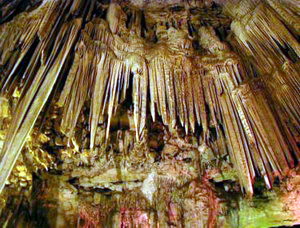
Michael's Caves in Gibraltar are situated some 300m above sea level on
the southerly end of the Rock of Gibraltar. They are a marvellous sight
with many truly impressive stalagmites and stalactites. It has long been
believed that the caves are bottomless which in turn gave credence to the
theory that there was once a subterranean link, about 15 miles long,
between Gibraltar and Africa and that it was through this that the Apes of Gibraltar, the only wild
monkeys in Europe, found their way onto the Rock many centuries ago.
Certainly they have their counterparts across the Mediterranean in Africa
and the only other feasible explanation for their appearance on mainland
Europe is that they were introduced by sailors who collected them on
their travels.
The caves have
been visited since Roman times but today's visitor has the benefit of
footlights and hand rails to assist them. It is still slippery underfoot
though so be sure to wear good footware. The main Cathedral cave is
an impressive site and during the Second World War was adapted to be used
as a military hospital. However it was never required as such and today
is put to a more peaceful use when concerts are held there. The acoustics
are wonderful.
The
rest of the caves consist of various interconnecting passageways with
some really impressive stalagmites and stalagtites. At some point in it's
past one of these enormous structures, unable any longer to bear it's own
weight, gave way and fell. In 1792 an inquisitive person removed a section
from the it's top end and this has left the interior of the stalactite
exposed, giving us a wonderful insight into the secret history of these
magnificent structures. It shows quite clearly in rings the history of
it's growth, for instance during periods of excessive rain its growth is
indicated by light-brown rings and patches and the darker areas were
formed during periods of less rain. Perhaps the two thin lines of crumbly
white substance are the most interesting part of its structure as it is
believed that these represent glacial periods.
During the preparation of
the caves for a military hospital the blasting required to improve
ventilation revealed a series of further caves and an underground lake.
However these can only be visited with a guide by prior arrangement.
One
of the best ways to get up to the caves is by cable car which operates
from the car park at the top end of the Rock. The car will take you to
the top of the rock from where it is a pleasant stroll down to St.
Michael's caves. This will also enable you to take in the wonderful views
of both the Atlantic and the Mediterranean and of course see many of
the Gibraltar apes. On leaving the caves you can then continue to walk
down until you reach the mid-way stage and pick up the cable car again.
For the less energetic you can take a trip in a taxi. The driver will
also take you to meet the apes, give you a potted history of the Rock
of Gibraltar and wait for you whilst you visit the caves.
Whichever
way you decide to do it a visit to both St. Michael's caves and to the
apes is a very enjoyable excursion.
Article
submitted by Ruth Polak the owner of www.costadelsol-vacationrentals.com
A web site specializing in holiday villas and apartments on the Costa del
Sol and in Rural Andalucia. You will also find lots of information about
Spain and Andalucia, in particular.