|
Germany
Travel Guide
Nuremberg
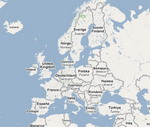
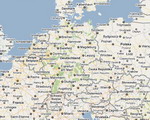
(German: Nürnberg) is a city in the German state of Bavaria, in the
administrative region of Middle Franconia.
It is situated on the Pegnitz
river and the Rhine-Main-Danube Canal and is Franconia's largest city. It
is located about 170 kilometres north of Munich, at 49.27° N 11.5° E.
Population (as of 01/2006) is 500,132.
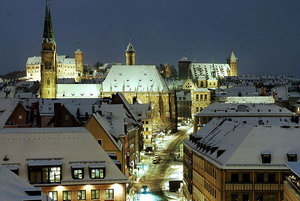 Nuremberg was
an early center of humanism, science, printing, and mechanical invention. Nuremberg was
an early center of humanism, science, printing, and mechanical invention.
The
city contributed much to the science of astronomy. In 1471 Johannes
Mueller of Königsberg (Bavaria), later called Regiomontanus, built an
astronomical observatory in Nuremberg and published many important
astronomical charts. In 1515, Albrecht Dürer, a native of Nuremberg,
mapped the stars of the northern and southern hemispheres, producing the
first printed star charts, which had been ordered by Johann Stabius. Around
1515 Dürer also published the "Stabiussche Weltkarte", the
first perspective drawing of the terrestrial globe. Perhaps most
famously, the main part of Nicolaus Copernicus' work was published in
Nuremberg in 1543.
Printers
and publishers have a long history in Nuremberg. Many of these publishers
worked with well-known artists of the day to produce books that could
also be considered works of art. In 1470 Anton Koberger opened Europe's
first print shop in Nuremberg. In 1493, he published the Nuremberg
Chronicles, also know as the World Chronicles (Schedelsche Weltchronik),
an illustrated history of the world from the creation to the present day.
It was written in the local Franconian dialect by Hartmann Schedel and
had illustrations by Michael Wohlgemuth, Wilhelm Pleydenwurff, and
Albrecht Dürer. Others furthered geographical knowledge and travel by map
making. Notable among these was navigator and geographer Martin Behaim,
who made the first world globe.
Sculptors
such as Veit Stoss and Peter Vischer are also associated with Nuremberg.
Composed
of prosperous artisans, the guilds of the Meistersingers flourished here.
Richard Wagner made their most famous member, Hans Sachs, the hero of his
opera Die Meistersinger von Nürnberg. Baroque composer Johann Pachelbel
was born here and was organist of St. Sebaldus Church.
Nuremberg
is also famous for its Christmas market, which draws well over a million
shoppers each year. The market is famous for its handmade ornaments and
delicacies.
Attractions
and things to do:
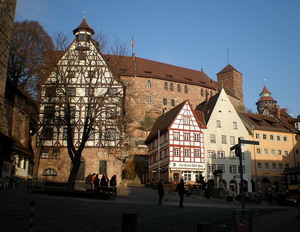 The southern
part of the old town, known as Lorenzer Seite, is separated from the
north by the river Pegnitz and encircled to the south by the city walls. The southern
part of the old town, known as Lorenzer Seite, is separated from the
north by the river Pegnitz and encircled to the south by the city walls.
- Nuremberg Castle: the three castles that tower over the city
including central burgraves' castle, with Free Reich's buildings to
the east, the Imperial castle to the west.
- Heilig-Geist-Spital. In the centre of the city, on the bank of the
river Pegnitz, stands the Hospital of the Holy Spirit. Founded in
1332, this is one of the largest hospitals of the Middle Ages.
Lepers were kept here at some distance from the other patients. It
now houses elderly persons and a restaurant.
- Hauptmarkt,
which provides a picturesque setting and famous market for
gingerbread. Nuremberg's star attraction is the Gothic Schöner
Brunnen (Beautiful Fountain) which was erected around 1385 but
subsequently replaced with a replica (the original fountain is kept
in the Germanisches Nationalmuseum). The unchanged Renaissance
bridge Fleischbrücke crosses the Pegnitz nearby.
- The following churches are located inside the
city walls: St. Sebaldus Church, St. Lorenz, Frauenkirche (Our
Lady's Church), Saint Klara, Saint Martha, Saint Jakob, Saint
Egidien, and Saint Elisabeth.
- Gothic St Lorenz-Kirche (St. Lorenz church, St. Lorenz), one of the most
important buildings in Nuremberg. The main body was built around
1270-1350.
- The church of the former Katharinenkloster
is preserved as a ruin, the Cartause is integrated into the building
of the Germanisches Nationalmuseum and the choir of the former
Franzikanerkirche is part of a modern building.
- The Walburga Chapel and the Romanesque
Doppelkapelle (Chapel with two floors) are part of Nuremberg
Castle.
- The Johannisfriedhof is a medieval
cemetery, containing many old graves (Albrecht Dürer, Willibald
Pirckheimer, and others). The Rochusfriedhof or the Wöhrder Kirchhof
are near the Old Town.
- The Tiergarten Nürnberg is a zoo
stretching over more than 60 ha in the Nürnberger Reichswald.
- There is also a medieval market just
inside the city walls, selling handcrafted goods.
- The German National Railways Museum
(German) (an Anchor Point of ERIH, The European Route of Industrial
Heritage) is located in Nuremberg.
- The Nuremberg Ring (now welded within an
iron fence) is said to bring good luck to those that touch it.
top
read more
|