|
Germany
Travel Guide
Ruegen
(German: Rügen) or Rugia is Germany's largest island.
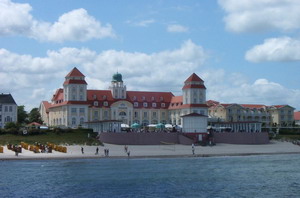 It is located
in the Baltic Sea off the coast of Mecklenburg-Vorpommern. Rügen
makes up the vast part of the Rügen District, which also includes the
neighboring islands Hiddensee and Ummanz, as well as several small
islands. Rügen is located in one of the most popular holiday and recreation
areas within Germany, comprising such seaside resorts as Binz and Sellin
and has more tourists per resident than any other location in Germany. It is located
in the Baltic Sea off the coast of Mecklenburg-Vorpommern. Rügen
makes up the vast part of the Rügen District, which also includes the
neighboring islands Hiddensee and Ummanz, as well as several small
islands. Rügen is located in one of the most popular holiday and recreation
areas within Germany, comprising such seaside resorts as Binz and Sellin
and has more tourists per resident than any other location in Germany.
Rügen
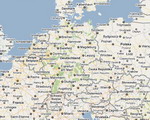
is located in northeastern Germany in the Baltic Sea and its shape is
distinguished by many smaller peninsulas. The Rügendamm bridge, which
connects the island by road and rail with the city of Stralsund on the
mainland, crosses over the Strelasund. There are also ferry connections
from Stralsund, Greifswald and Wolgast.
The
climate is in the temperate zone. The winters are not particularly cold
with mean temperatures in January and February of 0.0 °C and the summers
are cool with mean temperature in August 16.3 °C. There is average
rainfall of 520-560 mm and approximately 1800-1870 hours of sunshine
annually.
Two of
Germany's national parks are on the Isle of Rügen: Vorpommern Lagoon Area
National Park in the west (also including Hiddensee) and Jasmund National
Park, a smaller park including the famous chalk cliffs (Königsstuhl).
There is also nature reserve, Southeast Rügen Biosphere Reserve,
consisting of the peninsulas in the southeast.
Rügen
is one of the most requested holiday destinations in Germany. The island
has many popular seaside resorts along the eastern coast, such as Binz,
as well as quieter locations in the west. Several of the holiday resorts
are accessible via a historic narrow gauge railway employing steam
locomotives, called Rügensche Kleinbahn. Tourists come both to enjoy the
beaches and to explore the island's diverse landscape.
The
most popular locations are Binz, Sellin, Sassnitz and Bergen auf Rügen as
well as Cape Arkona.
top
read more
|