Lower
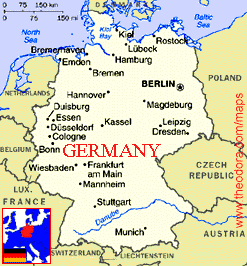
Saxony (German: Niedersachsen) lies in north-western Germany and is
second in area and fourth in population among the sixteen Bundesländer
(states) of Germany.
In rural areas Low German is
still spoken, but the number of speakers is declining.
 Lower Saxony
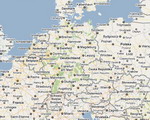
borders on (from north and clockwise) the North Sea, the states of
Schleswig-Holstein, Hamburg,
Mecklenburg-Vorpommern, Brandenburg, Saxony-Anhalt, Thuringia, Hesse and North
Rhine-Westphalia, and the Kingdom of the Netherlands.
In total, Lower Saxony borders more neighboring states than any other
federal state. The state of Bremen forms two enclaves within Lower
Saxony, one being the city of Bremen,
the other its seaport city of Bremerhaven. The state's principal cities
include Hanover,
Braunschweig, Osnabrück, Oldenburg, and Göttingen. Lower Saxony
borders on (from north and clockwise) the North Sea, the states of
Schleswig-Holstein, Hamburg,
Mecklenburg-Vorpommern, Brandenburg, Saxony-Anhalt, Thuringia, Hesse and North
Rhine-Westphalia, and the Kingdom of the Netherlands.
In total, Lower Saxony borders more neighboring states than any other
federal state. The state of Bremen forms two enclaves within Lower
Saxony, one being the city of Bremen,
the other its seaport city of Bremerhaven. The state's principal cities
include Hanover,
Braunschweig, Osnabrück, Oldenburg, and Göttingen.
The
northwestern portion of Lower Saxony is a part of Frisia; it is called
Ostfriesland (East Frisia) and lies on the coast of the North Sea. It
includes seven islands, known as the East Frisian Islands. In the
extreme west of Lower Saxony is the Emsland, a traditionally poor and
sparsely populated area, once dominated by inaccessible swamps. The
northern half of Lower Saxony, also known as the North German Plains,
is almost invariably flat except for the gentle hills around the Bremen
geestland. Towards the south and southwest lie the northern parts of
the German Central Highlands, the Weserbergland (Weser mountain range)
and the Harz mountains. Between these two lies the Lower Saxon Hill
Country, a range of minor elevations.
Lower
Saxony's major cities and economic centres are mainly situated in its
central and southern parts, namely Hanover, Hildesheim, Wolfsburg,
Salzgitter and Braunschweig. Oldenburg, near the northwestern
coastline, is another economic center. The region in the northeast is
called Lüneburger Heide (Lüneburg Heath), the largest heathland area of
Germany and in medieval times wealthy due to salt mining and salt
trade, as well as to a lesser degree the exploitation of its peat bogs
up until about the 1960s. To the north, the Elbe river separates Lower
Saxony from Hamburg,
Schleswig-Holstein, Mecklenburg-Western Pomerania and Brandenburg. The
banks just south of the Elbe are known as Altes Land (Old Country). Due
to its gentle local climate and fertile soil it is the state's largest
area of fruit farming, its chief produce being apples.
|