Piranha - Deadly and
Delicious by Larry M. Lynch
The Amazon is filled with
danger. Soldier ants march by the millions devouring all life in their
path. Submerged up to the eyes, Crocodiles lie in wait for the unwary -
whatever or whoever that may be. Undulating its 20-foot length beneath
the surface, the Anaconda, one of the world's largest snakes, uses
heat-seeking guidance to find its next meal. The barbed stinger in the
tail of platter-sized stingrays can inflict a wound that takes months to
heal. But none of these carry the fearsome mystique of the voracious
Piranha, the perfect killing machine.
They
had it even before we knew what was happening. My rod bowed in prayer to
something below the tea-colored water's surface. The six-pound test line
danced like a cat on a hot pavement. All hell had broken loose. Beads of
sweat rolled down Doris' back. Her clothes were now a second skin,
clinging to her every move. We panted for breath. We had fish on. The
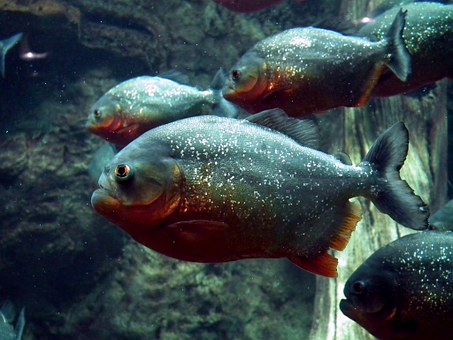
silvery oval-shaped body and red belly of a Piranha broke the surface. I
reached for it. "Don't let a finger get near their mouths or you'll
lose it", our native guide barked.
Minutes
earlier, I shuddered from a breeze escaping from somewhere up ahead
despite 85 degree-plus heat. The double-digit humidity didn't help
either. A maddening buzz filled my ears, but thanks my coating of Vick's
Vapor Rub, the blood-suckers wouldn't feast on me. My eyes burned. My
nose dripped. A coffee-table-sized leaf or hanging branch slapped into me
every few steps. Curses burst from my lips even with my best efforts to
become as one with the rainforest, as the indian had.
Our
fishing rods extended from 18" to five and a half feet. I'd hoped
the light mono would suffice, although I'd squirreled away spools of
twelve and twenty pound test as an afterthought. If we tagged into a
50-plus pound Tambaqui even that wouldn't be enough. Vines as thick as my
wrist dipped into light coffee-colored waters making little ripples as it
slid past roots and fallen branches. Tangled growth matted the gentle
slope of the bank into tea-with-milk colored wetness. I'd flicked a
thumbnail-sized chunk of bloody chicken liver on a barb-less hook with a
split shot into a dinner plate-sized swirl just beside a snarl of mangrove
roots jutting upwards through the surface.
Minutes
later, his tanned skin gleaming with moisture, our guide demonstrated the
efficiency of the scissor-like teeth. A green leaf held near the gaping
mouth instantly sported a neat, crescent-shaped bite. Three heavy blows
to the head prepared the killer for cleaning. After cleaning, the Embera
made a series of diagonal cuts along each side of the fish. Into these he
carefully rubbed a mixture of salt, garlic, and ground roots from a small
gourd he carried. A simple shaved branch frame held the fish over a smoky
fire of glowing coals. The firm toasted flesh tasted smooth and a bit
earthy, like a seasoned and mellowed catfish. With a wink and a sly nod
towards Doris he said. "Make these heads into soup and you will need
many wives". She glanced at me with a puzzled look. I smiled.
Ranging
through South America from Brazil to the lowlands of Peru, they also
inhabit waters in Venezuela, Guyana, Colombia, Ecuador and Bolivia. In
the Amazon and Rio Negro rivers of Brazil and the Orinoco River in
Venezuela, no creature is safe from the Piranha's razor-sharp teeth and
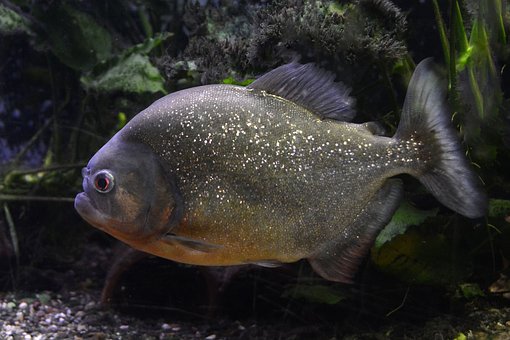
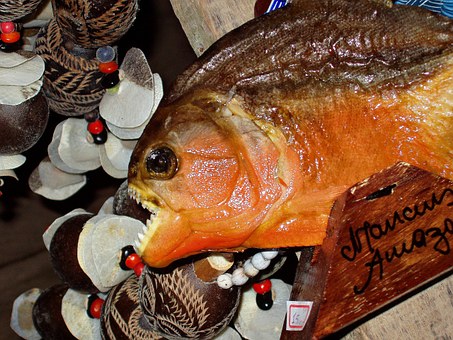
powerful jaws. The serrated teeth fit together like scissors, enabling
Piranha to cut the flesh from their prey. Like a shark, a Piranha's teeth
are replaceable, when one breaks off a new one grows in its place.
The
Yagua Indians of Peru often use the sharp edges between the teeth of a
Piranha jawbone to sharpen the point of their blowgun darts. A fish that
is dying or swimming erratically will be quickly attacked by a large
school. Piranha will also attack without warning to defend their eggs and
territory. A wounded animal that strays into the water will be stripped
to the bone so quickly it seems almost to "dance" on the
surface as it's ravaged from beneath. A bird that falls into the water
will be gone, feathers and all, in three minutes or less. A trapped fish
struggling in a net will be chewed clean to the head in a matter of
seconds. Attacks on large animals and humans are often dramatically portrayed,
but are rare. In some regions Piranha are known as "donkey
castrators".
"They
will rend and devour alive any wounded man or beast." U.S. President
Teddy Roosevelt said, adding, "Piranha are the most ferocious fish
in the world." Piranha, also called Caribe or Piraya only furthered
their fearsome mystique when Roosevelt encountered them during his
exploits in 1914. There are about 35 known species of Piranha but only
five species represent a danger to man. Species range from the Red-Belly
Piranha (Pygocentrus nattereri) with its characteristic red belly to the
largest of the carnivorous species, the Black Piranha with its demon-red
eyes and a 17 and a half inch long dark body weighing up to ten pounds.
It could remove a man's hand in two or three bites.
Most
species dine on fruit or seeds that fall into the water from overhanging
trees. The fish are not always aggressive. Women wash clothes in
knee-deep water where men spearfish while children bathe or swim in these
same Piranha-infested waters without harm. Further adding to the
Piranha's mystique, Indian men with half a dozen wives and up to a score
of children attribute their potency to Piranha-head soup, although no
scientific justification for the soup's potency yet exists.
Fishing for Piranha
Piranhas are usually part of
indigenous peoples diet in the areas where the fish are found. All you
need to go Piranha fishing are lines with a metal leader next to the hook
so the fish doesn't bite through the line, a supply of red, raw meat
(worms or cut-up fish will do too) and a bit of luck. Piranha swim in large
schools and are attracted by movement and blood. In May of 1999, hundreds
of anglers armed with rods, reels, and raw steak flocked to the Brazilian
town of Aracatuba near Sao Paolo for a one-Sunday piranha fishing
tournament. The townspeople had declared open season on the flesh-eating
fish, which had decimated other species in the local river. The prize for
the tournament was an outboard motor. But "most fishermen were
content to go home with plenty of the reputedly aphrodisiac
piranha", claimed then town spokesman Nelson Custidio.
Piranha,
earning their notorious reputation by reportedly killing 1,200 head of
cattle every year in Brazil, is some of the best eating in South America.
Whatever name you call them and no matter where you try them, when cooked
in a variety of ways, their firm light flesh with its smooth, slightly
nutty flavor, is a taste you're sure to enjoy.
Top
|